From legislative wins to regulatory insights: Highlights from the TBA Washington Conference
By Amy Heaslet, Executive Vice President/General Counsel, Tennessee Bankers Association
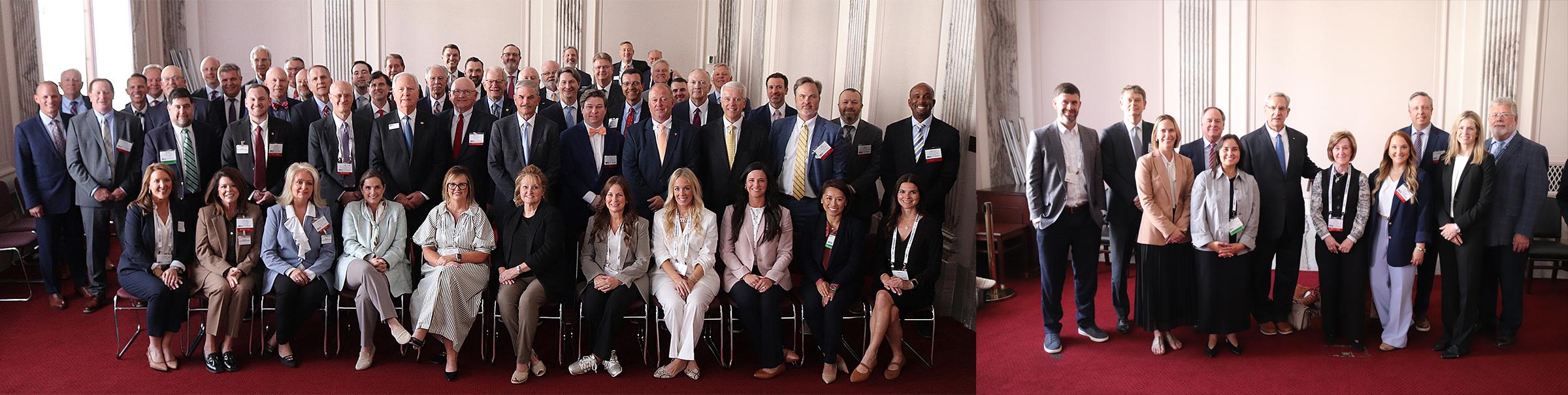
More than 90 Tennessee bankers, associate members, and association staff traveled to D.C. in May for the 2026 TBA Washington Conference. The conference, led by TBA Government Relations and BankPac Chairman Charlie Koon, marked a tremendous opportunity to advocate for priority legislative and regulatory issues for the banking industry, while meeting with FDIC Chairman Travis Hill, OCC Comptroller Jonathan Gould, Treasury Assistant Secretary for Financial Institutions Luke Pettit, and senior staff from the Federal Reserve and Tennessee’s Congressional delegation. Attendees also received briefings from ICBA and ABA and participated in a roundtable discussion with TDFI Commissioner Greg Gonzales and CSBS President and CEO, Brandon Milhorn.
Legislative Priorities
On Capitol Hill, bankers advocated for several key priority legislative issues that are pending before the House and Senate. With the expectation the Senate would soon release the language for the market structure legislation for digital currency – the Clarity Act – one of the top issues was advocating to include explicit language prohibiting stablecoin issuers or exchanges from paying yield on stablecoins.
As bankers know all too well, fraud imposes an immense risk to banks and their customers. While visiting with Congressional offices, bankers advocated for and asked for co-sponsorship of the SCAM Act (S. 3774 and H.R. 7548), which requires online platforms to verify advertisers, detect and remove fraudulent ads, and holds them more accountable to know their customers and protect consumers from becoming victims of financial fraud.
Bankers also asked their congressmen to support Chairman French Hill’s Main Street Capital Access Act (H.R. 6955), which aims to boost community bank lending by reducing regulatory burdens, simplifying capital rules, and encouraging new bank formation.
Also top of mind was the need to modernize deposit insurance. Because banking continues to evolve and deposit insurance has failed to keep pace, bankers pressed for modifications to coverage limits that are empirically based and data driven. Those principles are captured in several measures bankers advocated for, including Sen. Hagerty’s Main Street Depositor Protection Act (S. 2999), Sen. Mike Rounds’ Keeping Deposits Local Act (S. 2757), and Rep. Andy Barr’s TIER Act (H.R. 6553).
Bankers also used their time in DC to push back against credit unions. Specifically, bankers asked that Congress convene an oversight hearing to evaluate whether the $2.4 trillion credit union industry’s preferential tax treatment remains justified and that federal credit unions’ file publicly accessible Form 990s.
Regulatory Meetings
Bankers also took full advantage of having the ear of the agency heads at a time when they are reevaluating rules and policies and considering changes to help ease banks’ regulatory burden. Leading those efforts is Treasury, so the opportunity to hear directly from Treasury Assistant Secretary for Financial Institutions Luke Pettit came at a key time. Pettit’s remarks made clear the administration recognizes how unnecessary regulatory burdens hinder banks’ ability to lend and effectively serve their communities and customers.
Pettit spoke about Treasury’s awareness that policies created in the beltway trickle down and affect community banks and they appreciate feedback from bankers on what is working and what is not. Pettit specifically addressed the administration’s proposed overhaul of BSA requirements, noting that their goal is to shift from a “check-the-box” model to a risk-based framework and focus resources on higher-risk activities while evaluating programs based on effectiveness rather than technical compliance.
Bankers also thanked Pettit for his work and support in getting the 2025 funds released for CDFIs and shared that the program may see changes designed to address the bad actors but not limit the ability of CDFIs in good standing to continue to operate.
During the meeting with FDIC Chairman Travis Hill, TBA’s President Colin Barrett and bankers asked about the agency’s priorities and future goals. Chairman Hill made clear the agency understands the need for balanced regulation, exams to be focused more on risk, and reforms to CAMELS ratings. The agency will also begin discussing reforms for consumer compliance with their goal being to focus on consumer harm rather than process. Hill also plans to look at the future for IT exams given the emergence of AI and to make changes to encourage more de novo applications.
Bankers also met with Federal Reserve senior advisors Julie Williams and Amenda Roberts who spoke about the Fed’s statement of supervisory principles issued in November. Bankers also advocated for changes to their payments systems to protect against fraud and spoke about why they are hesitant to re-enter the mortgage industry.
The regulatory meetings wrapped up with a discussion with OCC Comptroller Jonathan Gould who emphasized the need to transparency, accountability and consistency within his agency. Gould also mentioned several initiatives designed to bring regulatory relief to community banks and allow for a fairer appeals process. He is also committed to seeing bank exams become more risk focused while strengthening their supervision without becoming an agency of enforcement only.
Conclusion
The Washington Conference is one of the most impactful events TBA hosts each year, and this year marked a critical time for Tennessee bankers to be in Washington. Not only did this year’s Washington Conference provide great opportunities for bankers to advocate for top issues facing the industry, but it also builds cohesion among Tennessee bankers as we all push forward to advance and strengthen our industry.
I urge all bankers to continue to remain engaged throughout the year and advocate for our industry alongside TBA. And please plan to join us next year’s Washington Conference scheduled for May 3-4.